


There’s a version of private practice that no one really prepares you for.
It’s not the clinical side. You’ve already done the hard part.
You’ve trained. You’ve invested. You know what you’re doing.
It’s not the passion either. You care deeply. Probably more than most.
It’s the moment where you step back and realize:
You did everything right.
And your business still feels harder than it should.
The schedule swings between too full and not full enough.
Revenue doesn’t quite stabilize.
Patients come in, but they don’t always stay.
Every visit feels like you’re starting over.
And at some point, the question shows up:
Is this just what owning a practice feels like?
It’s not.
The Hidden Problem Most Clinicians Don’t See
What most clinicians think they’ve built is a practice.
What they’ve actually built is a collection of services.
Consults. Follow-ups. Labs. Treatments. Packages that exist next to each other, but not within anything cohesive.
And services, on their own, don’t create stability.
They reset.
Every visit starts from zero.
Every recommendation has to be re-explained.
Every decision depends on whether the patient says yes in that moment.
There’s no continuity holding the experience together.
Which means:
Revenue fluctuates
Patient retention becomes inconsistent
And growth requires more effort, not better structure
This is exactly where friction starts to compound in a business. Not just for the patient, but for you.
Because when the model isn’t doing the work, the clinician has to.
Why Some Practices Look Easy
You’ve seen them.
The practices that seem to run clean.
Patients stay.
Revenue feels consistent.
The clinician isn’t rushing or overextending.
From the outside, it looks like they’ve figured something out that others haven’t.
They have.
But it’s not what most people think.
It’s not better protocols.
It’s not more certifications.
It’s not even more experience.
It’s structure.
The care is designed differently.
The journey is defined before the patient walks in.
The business model supports the medicine instead of working against it.
And everything is built to move the patient forward over time.
Not in isolated visits.
Not in disconnected treatments.
But inside a longitudinal care model.
What Changes When the Model Is Built Correctly
When care is structured, everything starts to shift.
Not dramatically. Not overnight.
But in a way that feels… cleaner.
Before
You’re explaining everything from scratch every visit
Patients leave “thinking about it”
You’re recommending instead of leading
Revenue feels unpredictable
Growth looks like more hours, not better systems
After
The patient journey is already mapped
Your recommendations feel obvious because they fit inside a system
Patients commit earlier and more confidently
Your calendar fills with the right patients
Revenue becomes predictable and scalable
And most importantly:
You stop feeling like you’re starting over every day.
From Visits to Continuity
This is the real shift.
From episodic care → to continuous care
From transactions → to transformation
From services → to systems
Because patients don’t actually want more visits.
They want clarity.
They want a plan.
They want to understand where they’re going and how they’ll get there.
And when that’s missing, they hesitate.
Not because they don’t trust you.
Because they don’t fully see the path.
This is why intentional practices don’t start with services. They start with outcomes, then build the structure to deliver them.
The Business Model Is the Lever
There’s a point where most clinicians hit a ceiling.
Usually somewhere between a few hundred thousand and low seven figures.
And the assumption is:
I need better protocols
I need more advanced training
I need to do more
But the pattern, across hundreds of practices, is consistent.
The difference between the practices that plateau
and the ones that scale
Is not clinical skill.
It’s how the care is packaged, delivered, and experienced over time.
That’s it.
Because a strong business model does a few critical things:
It pre-frames value before the visit even happens
It guides patient decisions instead of relying on persuasion
It creates continuity without constant effort
It removes friction across the entire experience
And it allows your clinical work to land the way it’s supposed to.
Why This Matters More Now Than Ever
The modern patient is not walking in the same way they did five years ago.
They are informed.
They are comparing experiences.
They are expecting clarity and ease.
They are not just evaluating your knowledge.
They are evaluating the entire experience of your care.
And the practices that are winning right now understand this:
The experience is the delivery vehicle for the medicine.
Which means:
If the structure is unclear, the value feels unclear
If the journey is fragmented, the results feel inconsistent
If the model is reactive, the patient experience becomes reactive
This is not a marketing problem.
It’s a model problem.
What Actually Becomes Possible
There is a version of your practice where:
Your offers are clear
Your patients stay longer
Your revenue compounds instead of resets
Your time is protected
Your systems support your clinical thinking
And your work feels sustainable again.
Not because you’re working less.
Because you’re working inside a system that actually supports you.
The Real Reframe
If you’ve invested in certifications, trainings, and protocols
and your practice still isn’t scaling the way you expected
It’s not a knowledge problem.
It’s a structure problem.
And once you see it, you can’t unsee it.
Where to Start
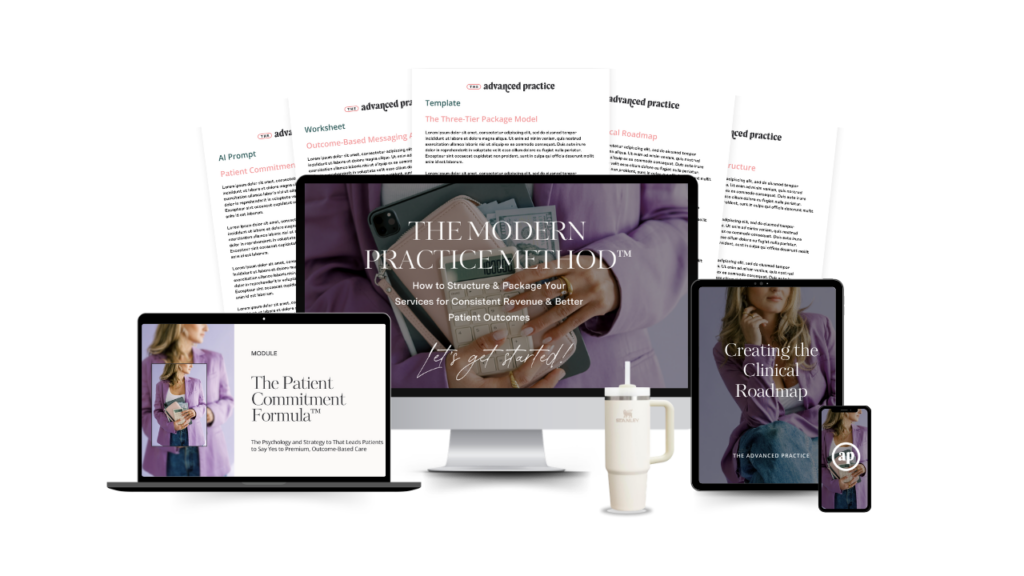
This is the work we do inside The Modern Practice Method.
Not adding more information.
Not giving you more tactics.
But helping you build the system your care actually needs to function at a high level.
Because the goal was never more visits.
It was always:
Better structure
Better outcomes
Better leverage
And a practice that finally feels as good to run as it does to envision.
Get Started with The Modern Practice Method 👇
posted by
Carmen Stansberry


Comments +